
From Toyota to HBO: How Bruton Stroube Outpost Powers Editorial and Color Reviews with Louper
From Toyota to HBO: How Bruton Stroube Outpost Powers Editorial and Color Reviews with Louper
Bruton Stroube is a multidisciplinary studio and production company based in St. Louis, Missouri. Their post division, Outpost, uses Louper to livestream edit and color reviews.
We spoke with supervising editor Lucas Harger, partner at Bruton Stroube and founder of Outpost, editor Bret Hoy and colorist Clark Griffiths, about livestreaming with Louper and incorporating Presentation Rooms into their remote workflow.
Can you tell us about your team at Outpost and the scope of work you do?
Lucas Harger: At this point we have seven full-time editors, as well as sound designers, a colorist, post producers - the whole post pipeline. We do everything from commercial Super Bowl spots to HBO documentary series and scripted features.

The opening shot for Honda '6666 Ranch'
Clark Griffiths: What attracted me to Outpost was obviously the great work that they do, but also the fact that they have in-house editors. So as a colorist, that means 95% of what gets edited here comes through me. I was looking for that variety: now I'm working on everything from features to commercials to a doc for HBO. On any given week I could touch ten different projects, and even if there are no client sessions I'll have work to do on the long-form stuff. The HBO series has five episodes of around 1000 shots each - they keep me pretty busy! Working with the team here also gives me confidence when I jump into a project: I've often seen the footage and early cuts, so I have a bit of a cushion to set looks and get things in a good spot for the clients.
Bret Hoy: I joined Bruton Stroube as a full-time editor four years ago, but I started off as a cinematographer and director, so my path to editing is a little bit different. The cool thing about working here is that it's a production studio as well as a post-production studio. So every day when we come in, there's a shoot happening on the photo or the video side, there are props being built, you get to see all the layers of production. So it's a cool place to come to work to. There's also so much that I've learned from being on the team, things you pick up just by being in proximity to other talented people. And having the infrastructure to help plan and schedule things is a huge deal as well.

Dramatic skies in Toyota 'Adventure Seekers'
Lucas, let’s look at your spot for Toyota Adventure Seekers - it’s an exhilarating edit!
LH: We’d done a national campaign for Toyota Racing and that transitioned into some work for their Trucks. For Adventure Seekers, we got access to footage from around ten other commercials that they shot in the campaign. They sent us all of the raw, uncut media, shot on locations around the country. We probably had 35 days of production footage to go through - so it was very editorial.
The creative team was from Saatchi & Saatchi. They’re really great collaborators with sharp ideas and instincts.
The footage was really awesome, it was beautiful. They had minimal boards as they wanted to explore the footage once I'd received it. I began playing with different approaches to pace, vibes and aesthetics, trying to give highs and lows, quiet moments and loud moments and make it as dynamic as the footage was. That led me to a more orchestral track - something that felt organic, that had those highs and lows. And then when I sent that over, we hopped on stream and they're like, “Yeah, that the one - let's start from there". The creative team was from Saatchi & Saatchi. They’re really great collaborators with sharp ideas and instincts. Especially as you go through rounds of reviews and higher levels of people start to engage with your cut, you understand why they are where they are in the organization. They’re just really creative and dialed in on what works and what doesn’t. They want to make a great spot, a great concept and a great commercial. And so it's really fun when I get the opportunity to work with them.
Toyota 'Adventure Seekers'
With this kind of edit, navigating so many scenes and storylines, the sound really needs to pull you through.
LH: Yeah, definitely. We wanted to create this organic experience of being outdoors - you want to feel it. If you're seeing the outdoors, that's only half of the equation, in my opinion. Then you need to bring in the sound, it feels more like nature if you hear it. So we really leaned into that. And then also the power of the trucks: the badassness of them, the weight and the depth and the presence. You can really amp that up as well.
The way that I approach editing in general is sound first. You can sell any cut with the right sound.
The way that I approach editing in general is sound first. You can sell any cut with the right sound. I get inspired a lot by sounds, so if I’m ever stuck in an edit, I'll just go through my sound library and think, “That's interesting. I know a shot that could go with that.” From a creative standpoint, the sound design was completely built in the edit, because you don’t know how long you can hold a shot, how you can transition, until you get the sound in there. I spent a lot more time in the bottom half of my timeline than the top half, for sure. And then obviously, they came in and did a really great mix.

Lucas' edit timeline for Toyota 'Adventure Seekers'
How was Louper used on this cut?
LH: There was no traditional director on this job, as the footage was from across multiple other shoots, so it was me and the creative director working together to bring it to life in the edit. Once you get into the big agencies and the national broadcast work, there are a ton of people in the room, physically or digitally. There were two people in Dallas, where Toyota's based, and two in Santa Monica. Everybody was from all over the place. So in these Louper streaming sessions, I’d have up to nine people in the room and they would just be on mute, camera off. And then I'd be working on the cut with the creative director and maybe the art director.
We had a Presentation Room and the Livestream Room going at the same time. They would jump over to the Presentation Room with their boss, get his feedback, then pop back over. We’d just keep that up for the duration of the project.
Then I'd export it, they'd send it off and we’d just sit on stream and wait. They would jump over to a Presentation Room with their boss, get his feedback, then pop back over. We’d get notes on the file, and then we'd get back to work. So we had a Presentation Room and the Livestream Room going at the same time, just bouncing back and forth. And we’d just keep that up all day for the duration of the project. They would use it as a working session too - they'd just jump at the opportunity to use Louper, they’d usually hang out in there during the project.

Stills from the 'Nashville Music City' campaign
Bret, let’s look at your spot for Nashville Music City - can you share a bit of background for the project?
BH: When we were approached to do the job, we knew that it had high production value; there were a lot of celebrities and cool people involved; and there were going to be a ton of different deliverables. So with all those different cuts there were just a lot of small changes and a ton of things to consider. They were delivered to broadcast and social, and there were a couple of scoreboard deliverables that we were doing too. The audio and the color was done through Bruton Stroube Outpost as well.
CG: Yeah, after the edit was locked, I hopped on a livestream with the director and the DP and we dialed in the look together. It was a lot of fun, it's just so easy to hop onto Louper. There were a lot of deliverables, but I just focused on the 16x9 footage, graded that and then Bret took it from there.
Nashville Music City
How scripted were the different deliverables, and how were you using Louper in the review process?
BH: They had quite a bit of coverage, but there was a pretty scripted idea of what they wanted each individual to say. So it was quite linear in that way. We were on Louper with the creative and the client, dialing in small changes like, “let’s swap this shot for this shot”. It’s really easy to jump on Louper and get the right answer straight away, instead of going back and forth with notes.
It’s really easy to jump on Louper and get the right answer straight away, instead of going back and forth with notes... we get to the best result faster.
BH: For me, having come from a background of shooting and directing, I'm used to the way you collaborate and come to solutions on set: it's just a dialogue back and forth. With editing, so often you send a cut and you get a note back and now you have to interpret that. I find it so much more effective, at least for my communication style, to get somebody on Louper and talk about it, in the context of what we're looking at right here, and make those decisions together. We get to the best result faster.

An epic shot from API 'Landman'
Can you talk about the vision behind the API Landman campaign?
BH: Bud Force is the director on this. He has a pretty distinctive style and he had a good vision of what he wanted to execute for each of these individual spots. And then we just jammed on it, came up with a few different versions and then worked with Bud to get more locked into what he was wanting. It really was an open creative process. The spots aired during Landman, so he obviously did pull on the visuals and the colors of that show. He actually did the color and audio all through Outpost too. And I know that he had a good time dialing in that color with Clark to match the Landman look.
The VO is actually from the people on-screen, they were just captured on site, in the environment. It's kind of tough to nail that, but they did.
The voice-over was delivered really beautifully, it had a natural, authentic feel.
BH: The VO is actually from the people on-screen, they were just captured on site, in the environment. They were interviewed and Bud was coaching them through specific lines as well. It's kind of tough to nail that, but they did. So in post we’d be finding certain things that we liked and piecing them together. I think Bud did a really good job communicating what he wanted and the tone of what he wanted from the start.
API x Landman
Why was Louper necessary for this job?
BH: Bud is down in Texas, so for the most part whenever we have to collaborate, it's on Louper. I think the benefit of Louper really is twofold. One, obviously you can jump on here and get solutions real fast, which is infinitely useful. But the other side of it, is just being able to communicate person to person and use visuals to communicate what we want to do. I am so much more used to that kind of collaboration. And when I think about a director wanting to work with me, that's probably the way that they'd want to talk: with visuals in front of them for reference. That's one of those things that Louper provides that I definitely see the value of.

A still from Honda '6666 Ranch'
Clark, you worked with Bud Force on the grade for the Honda 6666 Ranch spot as well as API Landman. What is it like working with him?
CG: We work with him a ton. He's a director, but he's also a cowboy and a horse trainer. He owns horses and he was the wrangler on a couple of seasons of Yellowstone. Taylor Sheridan created that show, and he owns the Four Sixes Ranch now. So Taylor and Bud have collaborated on a lot of things and that's kind of how this project came about. Bud has such a great way of capturing cowboys and the Western lifestyle, because that's what he does, that's what he lives. He knows what he wants and he captures great stuff. So it's always a pleasure to color projects like this. It looks authentic because it is.

A still from Honda '6666 Ranch'
It's always a pleasure to color projects like this. It looks authentic because it is.
Honda '6666 Ranch'
Lucas, overall, how has your team integrated Louper into your remote workflow at Outpost?
LH: We use Louper to livestream edit and color sessions, we have three rooms and they are in constant use. And then we use Presentation Rooms a lot as well. It puts clients in a different mindset when they're walking into a Presentation Room rather than a working stream, which is nice. And with the live note-taking - everyone can see the notes popping up as we're adding them. We can walk away from that session confident that all the notes are on the file we just presented. Nothing gets lost in an email thread or “which link was that?”
We use Presentation Rooms for more of the client-facing reviews, and for the creative working sessions we are on Livestreams all the time.

Still from Toyota 'Adventure Seekers'
LH: Some clients prefer Presentation Rooms when they're reviewing internally. They’ll say “Hey, can you set us up a Presentation Room? We need to show our boss, we need to show the CMO.” We'll just kick them a Presentation Room, load up the file and be like “hop on whenever you want to hop on”. I like that someone else can drive the ship, I don’t have to be in there. I just send a Presentation to the client and we'll designate that Room as theirs. And then when they're done, we take it down. So we use Presentation Rooms for a lot more of the client-facing reviews, and for the creative working sessions we are on Livestreams all the time.
It's had surprising applications for many different clients. It’s great because other people can drive and scrub. It sounds like it might get annoying to have another person controlling the playhead, but it's not, because they can go to where they want to go, so it’s very freeing. It makes the process more conversational - rather than the editor becoming a keyboard monkey. We offer it now as an option: “do you want to stream or do you want to do a Presentation Room?” It's a little bit of a mind shift - it's not a Review Link, and it's not a Livestream. It's in between.

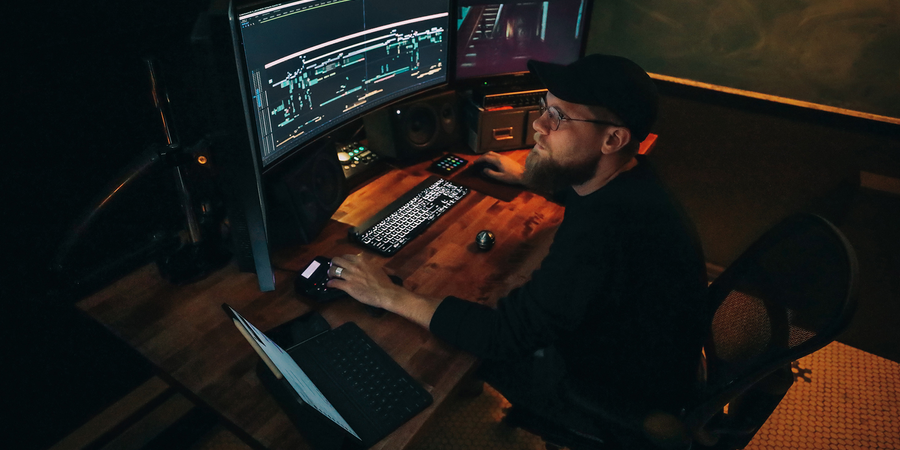
Lucas in his edit suite at Bruton Stroube Outpost
Lucas Harger is a partner at Bruton Stroube and founder and supervising editor at Outpost. Bret Hoy is an editor and Clark Griffiths is a colorist at Bruton Stroube Outpost.
Meet the Outpost editorial team and see their work.
Toyota Adventure Seekers campaign. Agency: Saatchi & Saatchi. Post House: Outpost. Editor: Lucas Harger. Color & Sound Mix: HARBOR
Nashville - Music City campaign. Agency: VML Kansas City. Director: Elizabeth Olmstead. DP: John Carrington. Post House: Outpost. Editors: Lucas Harger, Sam Baiamonte, Bret Hoy. Colorist: Clark Griffiths. Sound Mix: Mark Bartels, Steve Horne.
American Petroleum Institute - Landman campaign. Agency: Unreasonable Studios + Ultralite Films. Director: Bud Force. DP: Nick Dupuy. Post House: Outpost. Editors: Bret Hoy, Joey Diaz. Colorist: Clark Griffiths. Sound Mix: Mark Bartels - Broadcast, Alec Chojnacki (freelance) - Longform.
Honda - 6666 Ranch. Director: Bud Force. DP: Nick Dupuy. Post House: Outpost. Editor: Samuele Baiamonte. Colorist: Clark Griffiths. Sound Mix: Colton Jackson.
Images of Lucas in his edit suite, courtesy of Bruton Stroube.

Use Louper to stream and collaborate on live shoots, edit sessions, vfx reviews and more - securely and in seriously high quality.
