Louper Logo
Re-Recording Mixer Matthew Chan on Livestreaming Reviews for 'Halo'

Re-Recording Mixer Matthew Chan on Livestreaming Reviews for 'Halo'

Tatjana Meirelles PenfoldDecember 3, 2025
Enterprise Case Study

We caught up with Matthew Chan, re-recording mixer at Picture Shop in Toronto. He shared his experience working on the 'Halo' series; the challenges of adapting a gaming franchise for TV; and streaming Dolby Atmos in binaural, with Louper and Virtuoso.

What was your journey to becoming a re-recording mixer?

I've been working in post since the early 2000s. I was a musician and DJ, and I went to school for music recording. I quickly realized that I was not going to have fun doing music, I think I was too close to it, so I started working in film at a really small boutique studio in Toronto. I worked up the ranks until I was basically running the audio department and then went freelance. I wound up working in Toronto with Jane Tattersall's company, Tattersall Sound and Picture. And then through a number of acquisitions, it was incorporated into the Formosa Group, and now Picture Shop. Here in Toronto, Picture Shop has a domestic Canadian market, and then we do a lot of post-production for American TV as well.

Can you give me an idea of your role as a re-recording mixer: when does your involvement on a project begin, and who are the key people that you'd be working with, creatively?

On a film we're really working closely with the director, and on a TV show it’s usually the showrunner who is the main creative person. Generally speaking, I'm mixing the dialogue and music as the main re-recording mixer. And then there's a second re-recording mixer who's handling the sound effects and foley.

We're brought into meetings early on to understand the scope of what they want to do with the sound. Hopefully you can read a script and bring some of your own suggestions to the table. And then as we get closer to post-production, we get involved creatively. We get to attend spotting sessions with the producers and the showrunner, we stay in communication with the sound editorial and the sound design process. But we don't actually start working on the project until the pre-mixing starts.

On films, as soon as you get into the final mix, you’ll usually have a director sitting with you. But on TV shows, we usually get a pass at the episode before the showrunner sees it. And then the showrunner sees it, you’ll do a pass with them, and we’ll do another pass with the producers or network.

HALO-3.png

Master Chief John-117 (Pablo Schreiber) in 'Halo' Season 2.

Let’s look at the Halo series: the show obviously comes from the universe of the game. Did you ever play any of the games?

Yeah, I played a bunch of the really early games, and when we were tasked with doing the show, we were obviously very excited. It turned out, much to the chagrin of many of the fans, that there were a lot of things that had to break from the lore of the game. I think the main complaint is that Master Chief takes off his helmet and people were quite upset about that.

But in terms of the sound, the sound designer Brennan Mercer had a direct line to the game people from 343, through Microsoft, so he had access to all the assets from all the games. When he was developing weapon sounds, he would base them on the weapon sounds from the games. And he had license to take the roots of those sounds and make his own sounds, which was exciting for him. And then there were definitely a couple of genre sounds, like when they go through slip space and come out the other side, that had to harken back to the original sound.

But in terms of how the aliens speak and how Master Chief spoke and what the Spartan suit sounded like, we had to reinvent a lot of that. For example, in the game the aliens speak English and in the TV show they speak Sangheili, which is its own language developed for the show. And in the game, you're always in Master Chief's perspective, so you're hearing the dialogue over comms in a very specific way, but a lot of the TV show takes place in the “real world”. And then the sounds of the suits in the game didn't sound kind of heavy enough for the showrunners and producers, so we had to invent a sound for how big and menacing they were, but also kind of feel like they were able to control the suits in a way, so Brennan spent a lot of time on that.

HALO.png

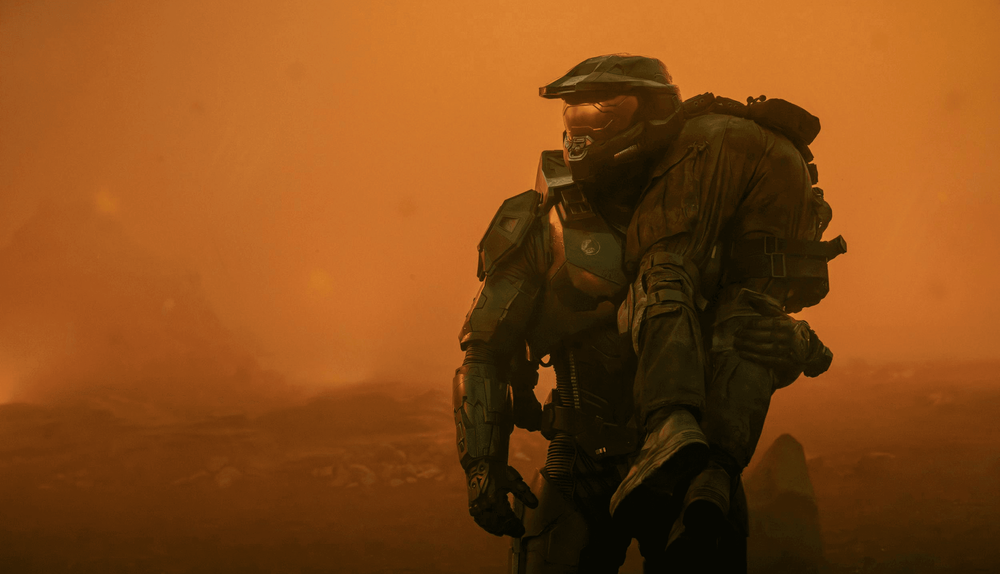
Master Chief searches for Bravo team on Sanctuary.

Can you talk about the challenges of mixing dialogue when there is a helmet involved?

On the first season I was doing the sound effects and Lou Solakofski was the re-recording mixer for dialogue. And there were quite a few different scenarios: you’re in Master Chief’s perspective, hearing the outside dialogue or his AI assistant Cortana from within the helmet; then you're outside of the suit hearing him transmitting from the suit; and then he takes his helmet off and you're hearing him talk naturally. So there are all these scenarios that we had to go through. But if a producer felt they didn’t like something, we'd have to go back through all the episodes and identify each instance of say, Cortana from inside the helmet, and change the sound. So it was a lot of work for Lou. He had different buses with different perspectives, playing out of different speakers, some in the ceiling, sometimes just wide stereo and sometimes just straight mono going through different convolutions for the helmet and different reverbs and plugins. In Season 2, we had a new showrunner, David Wiener, who wanted to dispense with most of that and make it a lot simpler, which I think worked better and was easier to deal with.

HALO-8.png

Master Chief and the Spartans meet their new boss.

Sound was quite an important theme in the story because of these flashbacks that Master Chief and Perez have, which were triggered or preempted by this audio feedback, this sort of static that they hear. There are themes of PTSD and how people hang on to trauma, and this transmission is like a symbol of that.

Yeah, David was the showrunner for Season 2 and it was a pretty drastic change from Season 1. He really wanted to ground it in the Spartans’ experience, the PTSD of working in the army, being a soldier. It’s good to hear that that came through for you because that was really important to him. And it made our jobs a lot simpler because we were able to lens it through a more singular focal point. It's hard to do for something like this that has such a fan base and is tied to such a huge franchise: you’re trying to honor what had happened in the video games, and the lore, and building the world. So yeah, it was really challenging but I think where we got to in Season 2 was a lot stronger for storytelling.

In terms of the sound they hear, there’s this development of the transmission that gets decoded over the course of the season, so Brennan, the sound designer, had to take what was going to be the inevitable final transmission and then work backwards. The transmission was a Sangheili prayer, so he'd have to take that recording, which thankfully they had done in advance, and then manipulate it backwards all the way into episode one to make those sort of garbled little bits that you hear when he's on top of the mountain before the fight.

HALO-9.png

Master Chief meets the Mother Shaman (Olwen Fouéré) on Sanctuary.

When you look at the visual spaces of the planets, like the Rubble or Sanctuary, they all look very different from one another. How do the visuals affect the way you approach the soundscape of different spaces?

That's a very good example of what you’d do in the spotting. You're like, what would you hear in this environment? There's a couple of sound editors who are designing the space sounds and the guns and things like that, but they're also building those worlds, figuring out what ambience to put in. Especially in Season 1 in the Rubble, there's a lot of background sound of clanking and machinery and yelling and life. So it's nice when the visuals support the contrast between those places because it makes our jobs a lot easier. It's very hard to do show where everyone's like, “I want all these environments to sound different”, but in every environment there are 500 people in the background or, every scene has the same cars in the background. It's nice when they've really thought about it visually ahead of time.

Did you have any favorite scenes?

It was really fun to work on some of the battle sequences. We had scenes back in the command post where they're talking to Master Chief who's in a battle on a covenant ship. So we had all these layers of comms: there’d be the principal dialogue between Master Chief and the command structure; then in the background on the radios, you would hear all this chatter of soldiers being killed, screaming, calling out battle commands and things like that; and then you'd have this sort of calm chatter of other military commanders giving orders over the comms. It was fun to take all those layers, dozens of tracks in separate streams, and then treat them all a little bit differently to make them all distinct. That was a big challenge but really enjoyable.

Screenshot 2025-11-19 at 19.13.49.png

Trailer for 'Halo' Season 2.

How long was the process of mixing Halo, start to finish?

Season 2 was at the end of COVID and then while the writers’ strike was happening. I think we probably spent three weeks on each episode in total, if you add up all the days in the pre-mix time, which is a lot for a TV show. It took probably six, seven months for the full Season and the last couple of months were obviously pretty heavy, really long hours. But David Wiener was great to work with, he was very focused and he had a lot of input, I learned so much. When you’re working on a show that big, they can change a lot of things and you can just keep going until you've got to deliver the show. But it was an amazing experience.

How were you running your live sessions?

In Season 1, it was during COVID and Louper didn't exist yet. We had producers like all over the world, LA and Seattle and England, and it was a bit soul crushing because we were mixing in Dolby Atmos and no one was coming to the facilities because everyone was locked down. So we had to try and live connect with them all, and we have an in-house engineer who developed a Chrome-based streaming solution. We used a piece of hardware to convert Atmos into a binaural experience, so the producers could get a spatial sense of what we're doing, rather than just sending a stereo feed.

And then for Season 2 we discovered Louper - it was pretty early days when we signed up. Louper was fantastic because it basically replicated the experience we’d had but it was even smoother. It was also a really smooth experience for our clients, which was important because in Season 2, though we did have the showrunner coming to the stage for most of the episodes, the producers didn't want to come in. They were just used to working from their offices and listening to the show remotely, so we wanted to be able to continue that experience for them.

HALO-11.png

The Arbiter (Viktor Åkerblom).

We went through a lot of testing to find a plugin that could convert Atmos into a binaural feed,

and we found one called Virtuoso made by APL. So we take the 7.1.4 Dolby Atmos Home Theater stream and convert it to binaural - live through the plugin. The binaural output is just a two channel feed, we send that to be mixed with the picture and that's what goes out over Louper. We’d sent all the producers the same set of headphones, so we know they’re all listening to the same thing. So if everyone was like, “there's too much bass” then we knew there was too much bass. That was really successful.

As long as everyone's wearing headphones, it works. And Louper is really great too, because we have the Room up the whole time. The sound designer was there, in case we needed something or wanted to run something by him, same with our dialogue editor. We would just send them a text, they’d join the Room and listen to something real quick. And even with David, there were a couple of times where we'd be doing our own pass unsupervised and at the end of the day, we’d get him to join us, check in for half an hour and give us some notes.

HALO-13.png

Master Chief's Mjolnir Armour.

When you run hybrid sessions, do you use a mic with a push-to-talk button?

Yeah, many of our sessions at Formosa have a mic where you push to talk, but I've insisted that we have auto talk-back, which is when when the transport is not rolling the mic is open. So my sessions are set up that we have a mic hooked up to the Avid S6 console and we're using the auto-talk back functionality in our monitoring system. So if we hit play, then the mic mutes and you can't hear anything from our room. And then as soon as we hit stop, the mic is open again. That way we can have a more natural feedback loop, as if you had someone behind you and you stop, turn around and talk to them. I don't have to reach over to find the microphone and unmute it.

HALO-TEAM.png

Matthew and team at final playback for 'Halo' Season 2 (L-R): Claire Dobson, Joe Mancuso, Brennan Mercer, Matt Chan, David Wiener, Kathleen Harris, David Caporale, Adam Stein, Nadya Hanlon, Graham Rogers, Nick Ianelli

People might not always be aware of the work you do, ideally if a mix is really well done it doesn’t call attention to itself at all.

Yeah, I think mixing is existential in a way, like, who's going to hear it like this? As a mixer, you’re listening to it on the nicest speakers at the loudest volume under such a microscope. Sometimes you get lost in the weeds a bit. But at the same time, if it doesn’t work it pulls the viewer out of the moment. And that's what a lot of mixing really is - it’s seeing things that pull you out of the moment and smoothing them out. That's most of what my job is, I'd say.

MATTHEW CHAN.png

Portrait of Matthew Chan.

Matthew Chan is a re-recording mixer at Picture Shop in Toronto.

Matthew worked on the 'Halo' series while at Formosa Group. In January 2026, Formosa Group Toronto was integrated into Picture Shop, an award-winning, global post production company offering comprehensive services including editorial, color, sound, and mastering.

Halo - Season 2 was developed by 343 Entertainment. Produced by Paramount Plus. Showrunner: David Weiner.

Cast: Pablo Schreiber, Natascha McElhone, Joseph Morgan , Christina Rodlo, Shabana Azmi, Natasha Culzac, Olive Gray, Yerin Ha, Bentley Kalu, Danny Sapani, Jen Taylor and Viktor Åkerblom. 

Matthew and his team used APL's Virtuoso to convert their 7.1.4 Dolby Atmos mix to a binaural feed, which was streamed via Louper to remote guests using headphonesSee how to set up a Louper livestream from Pro Tools using Blackmagic Hardware, or a Pro Tools Audio Bridge.

All Halo Season 2 still images and trailers courtesy of Paramount +.


Use Louper to stream and collaborate on live shoots, edit sessions, vfx reviews and more - securely and in seriously high quality.

Louper UI Preview